
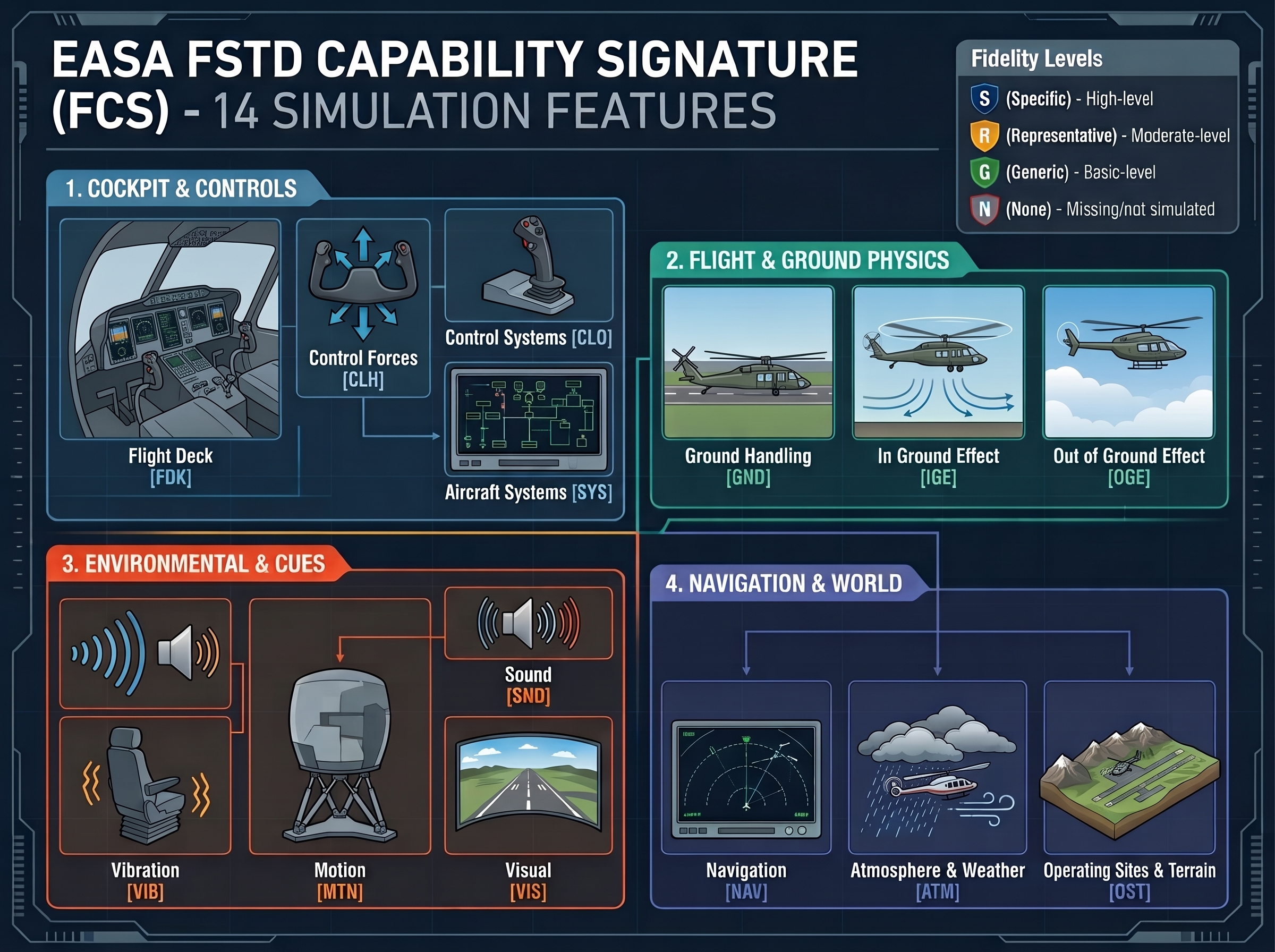
EASA has recently published its new rules for the certification of Flight Simulation Training Devices (FSTD). We covered the introduction of the new FCS rules and regulations in our previous article. You should really read it first so you understand the new language – Flight Simulation Evolution. In that article we alluded to some issues with the new regulations.
As time has gone on, it’s clear the regulators and operators have not recognised that latent flaws in the published rules. In the training and seminars that are circulating online, the focus has been heavily on getting the FSTD certfied but there is distinct lack of knowledge and discussion regarding the production of training FCS.
In this article we aim to lay out the significant problems with the new regulations and the threats this poses to aviation training organisations. There is a very real chance that highly capable FSTD other the FFS will be made obsolescent by the new rules and that perversely, training will be pushed onto live aircraft!
We will make the assumption you’ve read the earlier article – go grab a cup of tea, read the article then come back! We will also assume you are operating helicopters – this is Rotary Wing Geek after all. However, the same flaws likely exist for fixed wing training.
Let’s dig in.
Contents
FSTD Capability Signatures in 30 seconds
Haven’t read the previous article and want to get straight on with this one? OK here comes a firehose summary of the new regulations!
FCS
Instead of certifying FSTD into a very narrow group of simulator categories (Full Flight Simulator (FFS), Flight Training Device (FTD) and Flight Navigation Procedures Trainer (FNPT), they now get assessed under 14 different “features” in 3 groups, with 4 levels of possible fidelity in each level – the group of 14 characters is the FSTD Capability Signature (FCS). This allows training to be conducted on an FSTD with suitable fidelity:
- Aircraft simulation
- Cueing simulation
- Environment simulation
The level of fidelity for each feature is assigned a level:
- Specific (S) – The highest level of fidelity. (eg type and variant)
- Representative (R) – Intermediate level of fidelity (eg type)
- Generic (G) – Lowest level of fidelity (eg class of aircraft)
- None (N) – Not installed/functional or installed but not required
Equivalent vs Bespoke
At the end of the FSTD assessment by the authority, the FSTD can either get a “equivalent” FCS based on the old certification or a bespoke FCS based on a new detailed review of the FSTD.
For example an FFS Level D could just get an equivalent FCS that is the highest fidelity in each level (S – specific)

Alternatively you might do a detailed deep dive of your FSTD that was previously certified FTD3 and come up with this.

Training vs Training to Proficiency
At the same time, training organisations assess their training needs and work out what FCS is needed to either Train (T – initial introduction) or Train to Proficiency (TP – train to full competency) each task in their syllabus. So for example, training for a fuel dumping emergency requires less fidelity than a tail rotor failure. Achieving proficiency requires more fidelity in each case.

Task to tool
The training organisation then looks at their new matrix of FCS and looks at the available simulators, then makes use of the most appropriate simulator for each task element – this is the new “Task to Tool” methodology. The key benefit is you can use lower fidelity simulators where appropriate to reduce cost and free up capacity in higher fidelity simulators for the skills that really need it.
This is going to be a huge burden for training organisations but actually EASA have actually done the work already. In the new Appendix 9 to Part FCL, the authority have already laid out exactly what FCS is needed for each item in the type rating training syllabus and multi-crew co-operation course. Phew!
However, for any other course, it will be up to the training organisation to work out the necessary training FCS – so that includes the Instrument Rating, Commercial Pilot Licence course, instructor courses, operator training, specialist training (HESLO, HEC) etc. That is a tremendous amount of work that needs to repeated in each training organisation. So large workload, but that is not the issue here.
But organisations do not have to adopt this new training philosophy. They are good reasons why they shouldn’t!
The problem
The problem with the concept, is that it is critically flawed and will not function as intended. We are going to explain how this seemingly advanced concept is going to fail to deliver but first lets examine what will work.
Full Flight Simulator – Level D
An FFS D with attract an equivalent FCS under the new rules of S (Specific) in every feature. We saw that above already. This means that no matter what the training need is, whether at T (Training) or TP (Training to proficiency), an FFS D can do it. All the FFS D operators and all the training organisations that use them can relax. If you can stomach the cost of an FFS D and the time to get to one, you have practically no change in procedures due to the new regulations.
Less than Full Flight Simulator – Level D
Let’s now consider an FSTD that has a lower fidelity than S in one or more features.
Let’s say the simulation of the helicopter in an autorotation is a little unrepresentative of the specific type. Perhaps the rotor droop rate is a little slower than is realistic. Or perhaps the visual cues in the low hover are poor due to pixellated graphics. Now we end up with an R or G in that category.
No problem, we just won’t do autorotations in that simulator. But let’s see how that issue develops.
A scenario
Let’s imagine a fixed base FTD 3. That would attract an N for fidelity in the motion and vibration features. But otherwise its a pretty good simulator and has been used very successfully to date by a training organisation as an IFR training and checking platform for type ratings.
The training organisation
The training organisation decides to adopt the new training methodlogy and uses the training matrices in Part FCL Appendix 9 to work out what the required FCS is to complete training (T) and training to proficiency (TP) for the IFR element of a type rating. That is basically section 5 of the training syllabus in Appendix 9 of Part FCL.
Being a bit of a whizz at Excel, the head of training makes up a spreadsheet to show the matrix of training FCS for this part of the course.
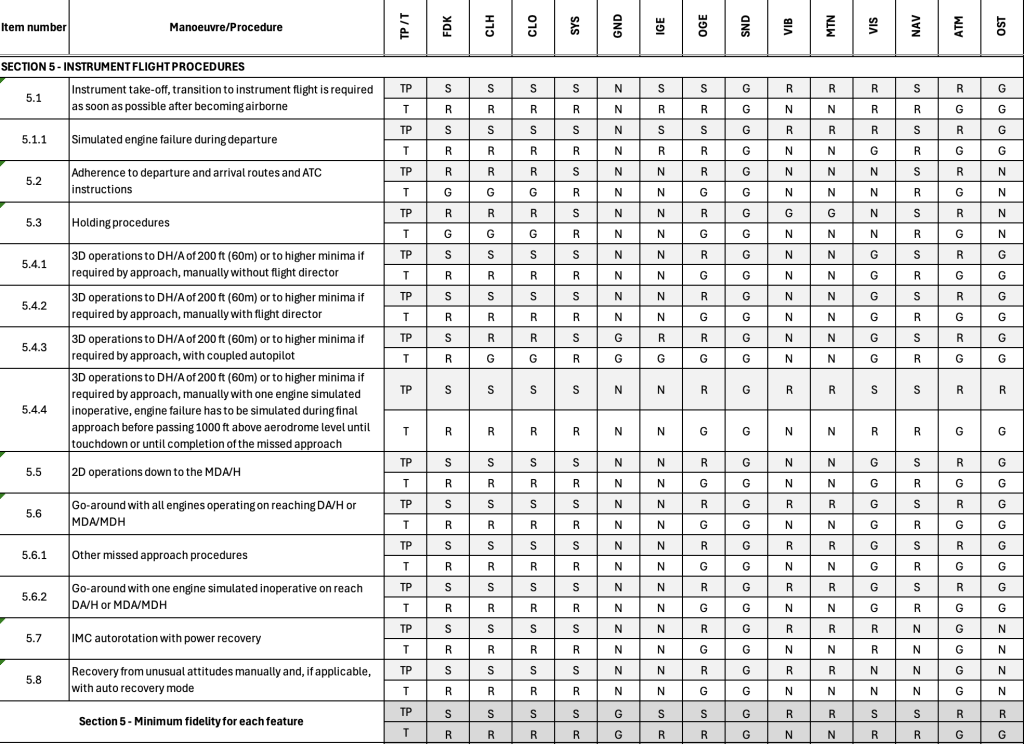
The head of training wants to do what he has been doing for years and complete all the IFR training and checking for a type rating in an FSTD. The training company has a nice fixed base one, that is really cheap to operate compared with the aircraft.
Looking at the matrix, the head of training extracts the combined training FCS from the bottom line and compares it to the FCS for the FSTD.
Crunch time
The FSTD has recently been certified under the new FCS scheme and as an expedient measure, the training organisation just accepted the “equivalent” FCS from the regulation for their FTD 3. It is as follows:

The head of training notes the N in the motion and vibration column and nods sagely that it makes sense as the FSTD is a fixed base one!
Now the head of training compares the training FCS for IFR training with the FSTD FCS and looks at how they match up.
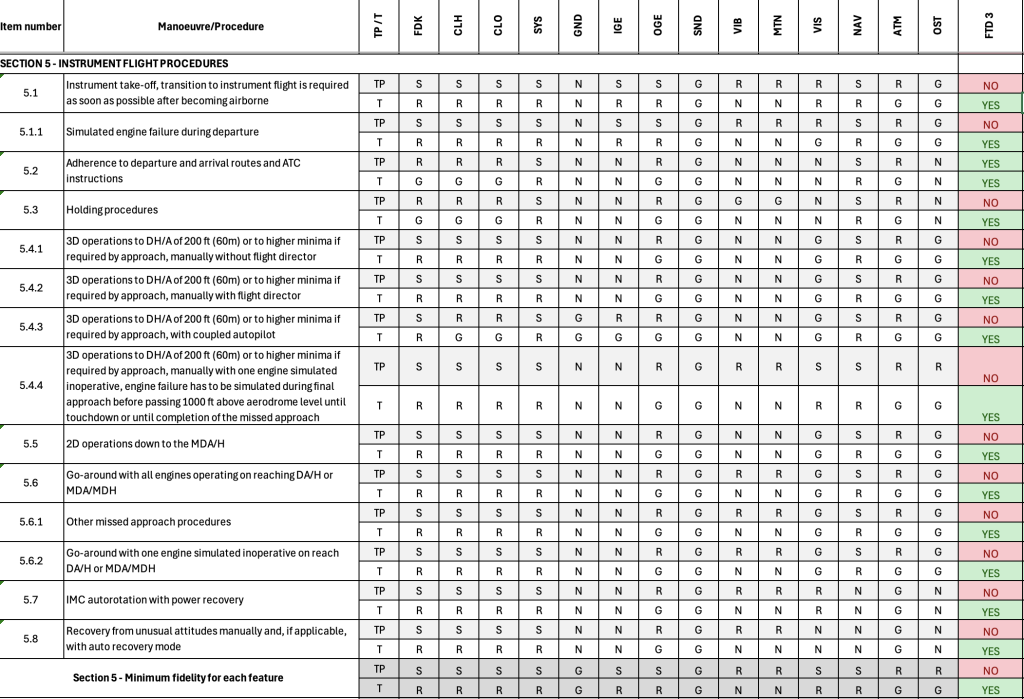
A step back
The head of training is very disappointed. For nearly every item in his IFR syllabus, the FTD3 is only suitable for T level training – an introduction to the item. The only item that matches the FSTD for TP (Training to Proficiency) fidelity is “adhering to ATC instructions”. So that single item can be checked in the FSTD but nothing else. This is a huge backwards step for the training organisation. They now need to use expensive aircraft time and precious instrument training slots for every type rating.
The head of training decides to check the rest of the syllabus to see what can be flown in the FSTD. The results are grim:
- Almost none of the initial cockpit checks can be Trained let alone checked in the FSTD
- Just 25% on the visual flight manoeuvres can be Trained in the FSTD
- Only around 33% of abnormal procedures can be Trained in the FSTD
The FSTD can be used for MCC training but it is looking pretty useless for anything else.
A bespoke FCS?
The head of training could go try to find an FFS D with free slots but decides to get the FSTD certified again, but using a detailed analysis of the features. The workload during the assessment is huge. The team approach burn out getting the task completed.
Let’s imagine the head of training gets his FSTD up to S level in everything except the motion and vibration (quite unrealistic but it illustrates a point). Bringing that up to even G (generic) fidelity in motion is cost prohibitve for the organisation. The new FCS for the FSTD is:

Still not quite there
Our head of training runs the comparison again:
- The cockpit checks can now Trained but still not checked
- The visual flight manoeuvres can be Trained in the FSTD but not checked (TP)
- Only around 66% of abnormal procedures can be Trained and checked (TP) in the FSTD
- About 50% of the IFR skills can still not be checked (TP) in the FSTD
The head of training still needs to use an aircraft for the IFR training despite doing the best upgrade possible of a fixed base simulator.
This leaves the head of training with a real issue:
- The course is now heavily disjointed. A VFR sortie in the simulator becomes an abbreviated lesson avoiding core manoeuvres (eg a transition to forward flight) out because they don’t count to the syllabus minimums. The elements that can be trained in the FSTD are bizarre collections of unconnected events.
- The training that cannot be conducted in the simulator now must be conducted in a FFS D that is heavily oversubscribed, expensive and far away.
- Due to lack of FFS D availability, training is pushed back into the aircraft leading to poorer quality training and/or more risk to life. The accountable manager is displeased!
A wider problem
The problem is not just with fixed-based FSTD. Other features, aside from motion and vibration are sticking points.
Take for example the fidelity feature for ground handling. This needs to be of a defined level for many tasks. Even for a skidded aircraft, the way an aircraft settles on to its skids or slides on those skids in a running landing is key to good quality training. If the fidelity of that item were dropped below R (representative), an analysis reveals the FSTD is significantly less useful that an FTD3 as currently certified.
Back to the scenario – outcome 1
Our head of training decides to come at the problem from the other end. They look at the training FCS and work out the minimum simulator needed to be able to do what can currently be done in an FTD3 (training and checking IFR and limited training VFR). They come up with the following FCS:

This is the sweet spot. IFR training and checking can be done in the FSTD. All of the VFR training (and some checking) can also done in the FSTD. The cost of this simulator is just shy of an FFS D. The organisation just buys an FFS D and eliminates the problem.
FCS has failed.
Back to the scenario – outcome 2
The head of training is now looking at the Instrument Rating course. There is no training FCS so they decide to approach the problem from the other end. They look at the available FSTD and get the FCS for them.
Then the head of training takes that FCS and reverse-engineers the training FCS so that the FSTD can be used for the whole course in line with current usage. There is no change from the status quo except a slightly burnt out head of training. The training FCS is “shelfware” to satisfy a regulation without improving training. This is a bad behaviour but he wants to remain competitive in the training sector.
FCS has failed.
The solution(s)
So what is the solution? Can the FCS system be made to work?
Authority Definitions
CAAi have outlined one possible solution in recent seminars for the issue of every organisation having to work out a training FCS for every other course except type rating training.
They have proposed that the authority defines the training FCS for each course. The work would be done once, then included in regulation for everyone to use. The workload would be dramatically reduced across industry and perhaps more importantly it would be give a level playing field so each organisation was using the same fidelity for the same course.
However, this would create the same problem that already exists. The training FCS defined for type rating training is simply too demanding for some of the training items that exist. FTD3-level simulators are currently used for significant amounts of IFR training and checking. This is a well-trodden, safe way of training and FCS should support that, not remove it as an option.
What is needed is a re-assessment of the defined FCS in Appendix 9 to ensure they are correctly tailored to the training need! And more importantly allow what is already taken as being safe and sensible.
Surely someone noticed this before?
Just one last point. Every regulation that gets published must first pass through process where the proposed regulation is pushed out for comment. Surely someone noticed this problem at the NPA stage?
Funnily enough they did.
In a list of comments made by industry on the proposed regulations (see this document on the EASA website), one of the comments was:
- “The training matrices proposed in NPA 2020-15 did not promote the use of existing FSTDs like FTD 2 or FNPT II MCC that could be valuably used for SP HPA complex type rating training. With the proposed amendments in NPA 2020-15, most of the FSTDs currently used in approved SP HPA complex type training courses would not meet the fidelity level required in the matrix.” (SP HPA is single pilot high performance complex aircraft)
Yes, it’s aeroplane focused but it is exactly the problem that is now going to occur in helicopters. The document also reveals how this issue arose:
- “The training matrices in the new proposal were created by training experts who analysed each training task while working individually and without influence from others.”
The fundamental point that was missed, was to analyse the status quo and see what was actually already working.
Other comments reveal yet more problems. There are some astute observations that the FCS is focused on tasks – “flying an ILS”. More broadly aviation training is moving to competencies – “flight path management – automation”. The new regulations do not cater for that.
Summary
With regret, the helicopter training FCS regulations are not going to work. Only organisations managing or using FFS D are going to escape the issues this new regulation brings in its current form. The fidelity level has been set too high for many tasks and training is going to be pushed up the fidelity scale rather than down.
What do you think?
- FSTD Capability Signatures (FCS) – A hidden threat for training?
- Preparing for complete loss of engine power in helicopters

- Lessons in how to manage a helicopter engine malfunction
- Light twin helicopter AFCS – Have Airbus won the race?
- Maintenance by pilots – can the training be improved by sharing?

- Flight simulation revolution – A new method for matching training need to simulator capability
- Helicopter Single Engine IFR – New horizons

- Making the grade – understanding climb gradients in the go around

- Unfair Skies: Restrictive helicopter instructor rules and how to fix them

- How to create an instrument rating instructor (IRI) – A helicopter anomaly
- The evolution of Category A Helipad procedures – A strong foundation for VTOL to learn from?

- Strips vs dials – Which is better?
- Under the weather – are UK HEMS weather rules broken?

- Mastery of the GTN 750 – Ten things you should know
- Checking anomalies – The weird requirements of helicopter proficiency checks
Leave a Reply